While I usually write about HFT, my childhood fascination with space has never waned. There is a raw engineering beauty in rocketry that feels very similar to optimizing trading systems. Both are ultimately exercises in fighting the limits of physics.
At the heart of SpaceX's success is the Raptor engine. It's not just an incremental improvement over their older Merlin engine. It's a complete paradigm shift. Let’s look at how they did it, and the engineering decisions that changed everything.
The Birth of Merlin: SpaceX’s First Production Rocket Engine
Merlin was built for one thing: survival. Back in the early 2000s, SpaceX was a scrappy startup with a tiny budget and a string of early launch failures. They couldn't afford complex systems. They needed an engine that was cheap, reliable, and simple.
Musk funded the early days out of his PayPal earnings, and the constraints dictated the engineering. The Merlin had to be simple enough to build without massive aerospace budgets, forcing a design focused strictly on the essentials.
How the Merlin Engine Works
The physics of a rocket engine are pretty straightforward: you mix fuel and an oxidizer, ignite them in a chamber, and direct the exhaust through a nozzle. The Merlin does this using RP-1 (refined kerosene) and liquid oxygen (LOX).
To pump these propellants at high pressure, Merlin uses a gas generator cycle. This is an open-loop design: a small amount of fuel and oxygen is burned in a separate burner to spin the turbine that drives the main pumps. Once that turbine does its job, its exhaust is just dumped overboard. It is simple and highly reliable, but you're wasting potential energy by venting that exhaust.
Transitioning to the Raptor: A Leap in Engine Technology
While Merlin got Falcon 9 to orbit and made first-stage landing a reality, it hit a wall when it came to Starship and Mars. For a fully reusable, multi-planetary vehicle, SpaceX needed a completely different beast. They needed the Raptor.
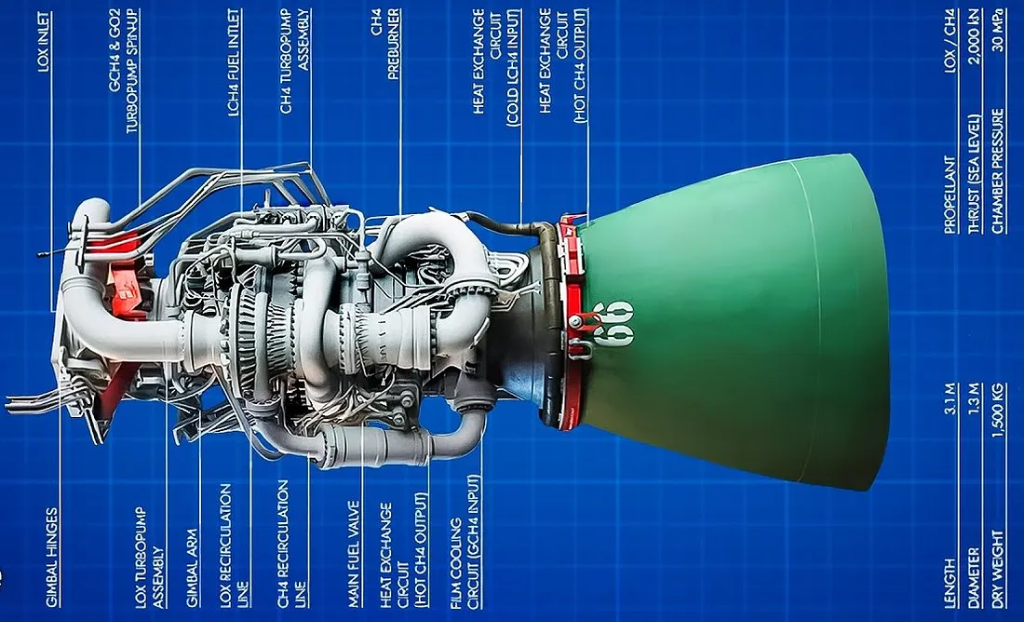
Why Methane?
The first big shift was moving from kerosene to liquid methane. Methane is a game-changer for two reasons:
First, it burns incredibly clean. Kerosene leaves soot (coking) inside the engine's internal channels, requiring deep cleaning and maintenance between flights. Methane leaves virtually no residue, which is essential when your goal is rapid, airport-like turnaround times.
Second, you can synthesize methane on Mars using the Sabatier reaction by combining atmospheric carbon dioxide with water ice. If you want to fly back from Mars, methane is the only logical choice.
Full Flow Staged Combustion Cycle
The real magic of the Raptor is its cycle: the Full Flow Staged Combustion (FFSC) cycle. It is the holy grail of rocket engine design.
In Raptor, nothing is wasted. It uses two separate pre-burners: one runs oxygen-rich to spin the oxygen pump, and the other runs fuel-rich to spin the fuel pump. The crucial part is that the exhaust from both turbines is fed directly into the main combustion chamber. Because the propellants enter the chamber as hot gases rather than liquids, they mix instantly and burn with near-perfect efficiency.
FFSC had never been flown before. The Soviets built a prototype (the RD-270) in the 60s, and Rocketdyne tested one in the 2000s, but SpaceX is the first to actually fly and mass-produce it.
Superior Performance Metrics
The engineering payoff is massive. Raptor operates at a chamber pressure of over 300 bar, generating immense power from a compact frame.
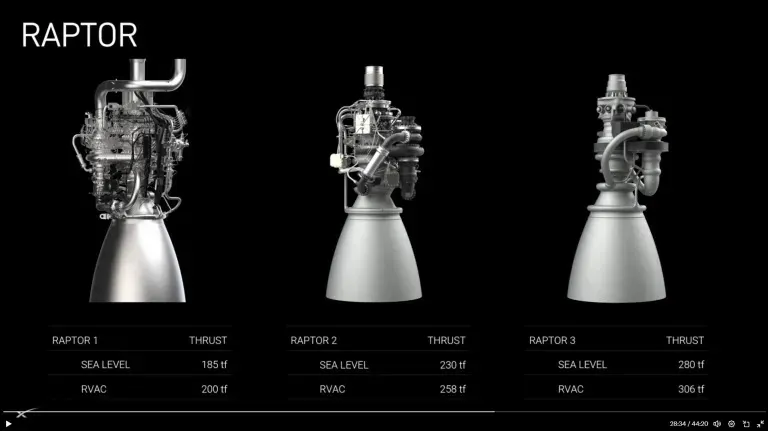
This extreme pressure means the engine can be physically smaller while producing much more thrust. A single Raptor 2 produces 230 metric tons of thrust. This compact size allows SpaceX to pack 33 of them onto a single Super Heavy booster, producing over 16 million pounds of thrust at liftoff, which is more than double the Saturn V.
The Path Forward: Simplifying and Accelerating Innovation
But the real genius of the Raptor's evolution isn't just the physics. It's the manufacturing. In the transition from Raptor 1 to Raptor 3, SpaceX aggressively applied Musk’s rule: the best part is no part.
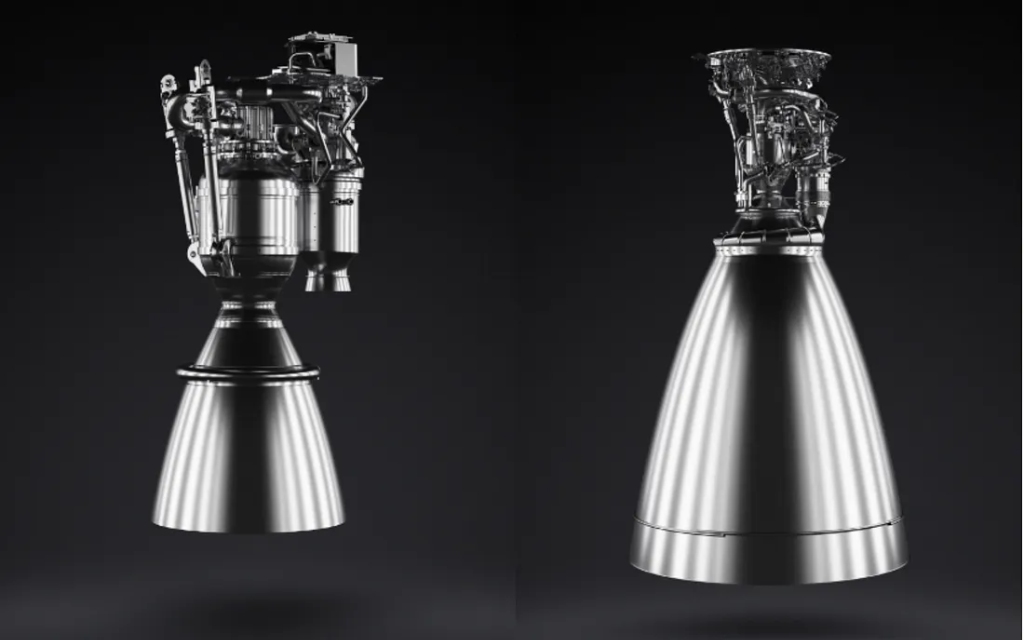
If you look at Raptor 1, it was a mess of external plumbing, sensors, and wiring harness wrap. It looked like a prototype because it was. Raptor 3, by comparison, looks like a single clean block of metal. They integrated the plumbing directly inside 3D-printed metal structures and removed hundreds of individual components. It is lighter, cheaper, and has far fewer points of failure.
The Bigger Picture: Envisioning a Fleet of Starships
SpaceX's goal isn't just to build a cool engine. It's to build a logistics fleet. To make Mars travel viable, they need thousands of Starships, which means producing engines at car-like scales. With Raptor 3's simplified design, they're moving closer to an engine that can be mass-produced on an assembly line.
Conclusion
As an engineer who spends my days looking at system architecture and low-latency code, seeing the Raptor’s evolution is incredibly satisfying. It's a masterclass in first-principles engineering: starting with a complex, bleeding-edge machine, and relentlessly refactoring it until only the essential structure remains. SpaceX didn't just build a better engine. They proved that you can iterate hardware at the speed of software.