In high-frequency trading, speed isn't just a feature. It's the entire business model. When execution times are measured in nanoseconds, C++ is the only logical language choice because it lets you get as close to the hardware as possible without writing raw assembly. Here is a practical breakdown of low-latency optimizations used in HFT matching engines, focusing on cache locality, compile-time dispatch, and lock-free memory structures.
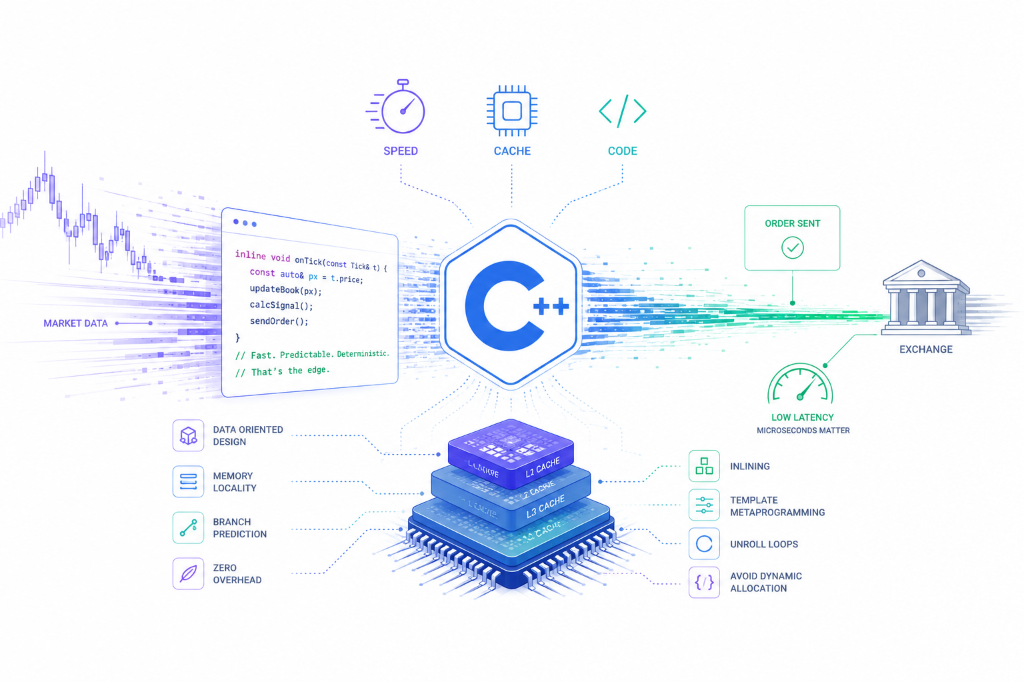
The HFT Hustle: Why Speed is King
In traditional software design, you optimize for throughput or clean architecture. In HFT, you optimize for queue position. If your trading system receives a market feed update and decides to hit an order, your packet is racing against dozens of other firms. If you are even a microsecond late, you hit adverse selection, meaning you only get filled when the price has already moved against you. Every nanosecond saved directly correlates to PnL.
Breaking Down the HFT Universe
An HFT system architecture is generally split into distinct components:
• Market Data Feeds: Decoders that parse binary UDP multicast packets from the exchange matching engine.
• Order Management Systems: Encoders that build and send execution packets (usually TCP or specialized protocols like OUCH) to submit or cancel trades.
• Trading Strategies: The core math engines that calculate signal valuations based on order book state.
• Pre-Trade Risk: Inline validation checkers that verify position limits before letting any order hit the wire.
C++: The Ultimate Power Tool
Why C++? The simple answer is control. C++ gives you deterministic resource management. There is no garbage collector to trigger random, millisecond-long pauses. You control exactly when memory is allocated and freed. Additionally, template metaprogramming and constexpr allow you to shift decision-making from runtime to compile-time, doing the heavy computation before the market even opens.
Cache Locality and Cache Warming
L1 cache access takes about 1 nanosecond, while main memory (DRAM) access takes roughly 60 to 100 nanoseconds. If your hot-path code has to wait for data to be fetched from DRAM, your execution speed drops by two orders of magnitude.
To maintain high cache hit rates, write cache-friendly code by laying out data sequentially in memory using contiguous arrays instead of linked lists.
In addition, for paths that execute infrequently but must be incredibly fast when triggered, use cache warming. This involves repeatedly running the execution path with mock data to keep the instructions and data hot in the L1/L2 cache.
Compile-Time vs. Runtime Dispatch
Polymorphism is standard in clean object-oriented design, but virtual function tables (vtables) introduce runtime overhead. A virtual call requires an extra pointer dereference and prevents the compiler from inlining the call.
In latency-critical paths, replace virtual functions with template metaprogramming or Curiously Recurring Template Pattern (CRTP). This resolves dispatch decisions at compile time, enabling the compiler to inline functions and optimize register allocation.
Constexpr and Inlining
Using constexpr shifts calculation cost entirely to compilation. If a mathematical formula or configuration parameters are known beforehand, compute them at compile time.
Inlining is equally critical. Marking small, hot-path functions as inline (or using compiler-specific attributes like __attribute__((always_inline))) eliminates the overhead of function calls (pushing parameters to the stack, jumping, and returning) by pasting the function body directly into the caller.
Loop Unrolling
Loop unrolling reduces loop control overhead (incrementing counters and conditional branching). By manually or automatically unrolling loops, you allow the CPU to execute instructions in parallel via pipelining.
Lock-Free Concurrency and Ring Buffers
Traditional thread synchronization using mutexes is too slow for HFT. If a thread blocks waiting for a lock, it context-switches, adding microseconds of latency.
Instead, use lock-free data structures. The Disruptor pattern, utilizing a lock-free ring buffer with atomic operations (std::atomic with relaxed or acquire-release memory orders), allows multiple threads to produce and consume messages without blocking.
Branch Hinting and Prefetching
Modern CPUs guess the path of conditional jumps. A branch misprediction flushes the instruction pipeline, costing 10 to 20 cycles. Use compiler hints like [[likely]] and [[unlikely]] to guide the compiler on the hot path.
Additionally, if you know you will access non-contiguous data soon, use software prefetching (like __builtin_prefetch) to load data into cache before the CPU execution reaches that instruction.
Data Types: Signed vs. Unsigned and floats vs. doubles
Choice of data types has subtle latency implications. For loop index variables, signed integers are sometimes slightly faster to optimize because compiler overflow rules are less strict.
Furthermore, avoid mixing float and double in numerical calculations, as implicit conversions require CPU conversion cycles. Stick to a single type across your computation pipeline.
Conclusion
Optimizing C++ for low latency is an iterative cycle of writing cache-aware code, shifting runtime checks to compile-time constraints, and compiling with strict optimization flags. It is about matching your software architecture to the underlying physical layout of the CPU, memory lanes, and network card.